Log 002: The Consistency Crisis
Most AI art lacks visual coherence over time. Learn why taste and the act of discarding are your only moat in the generative AI era.
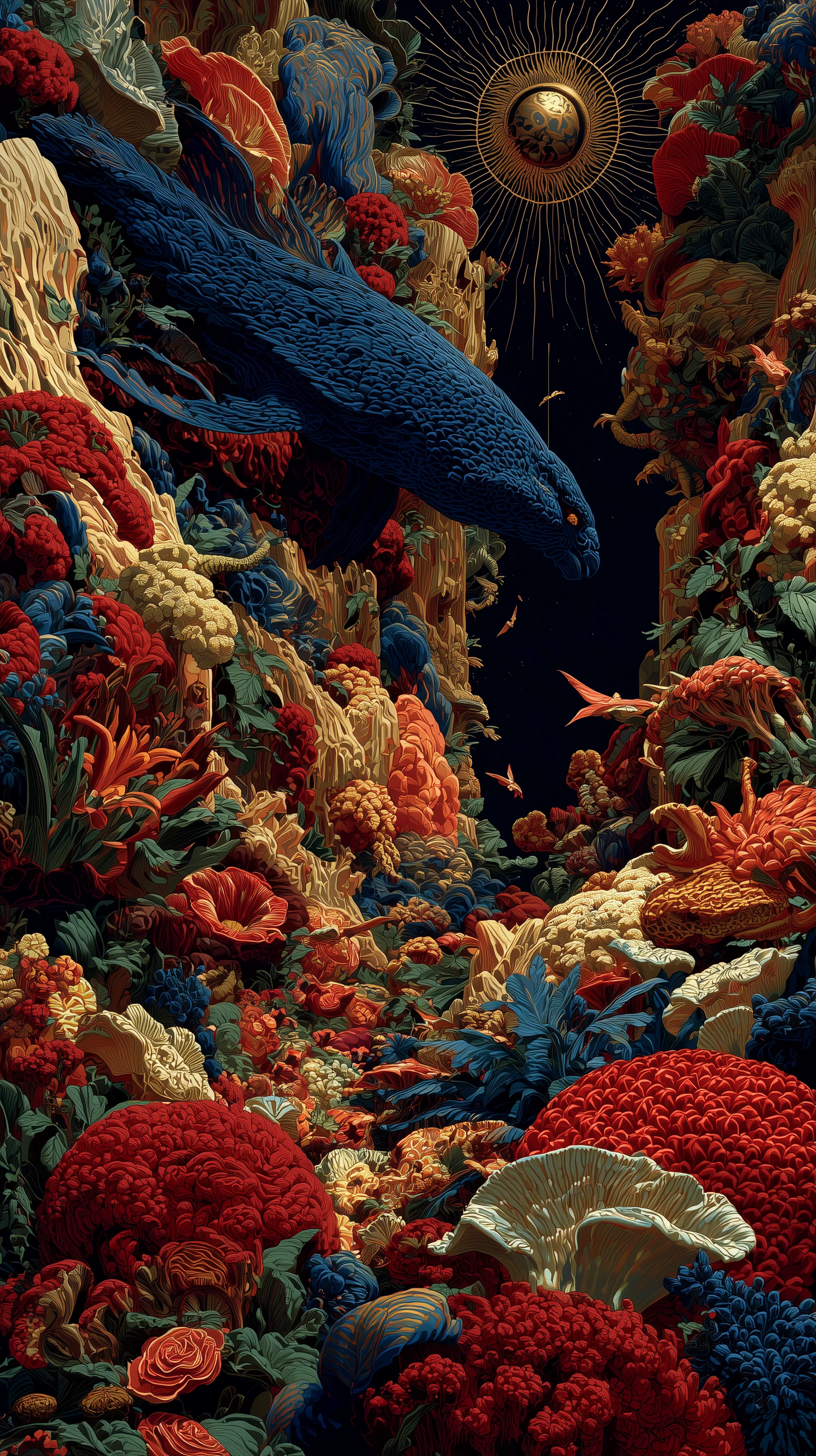
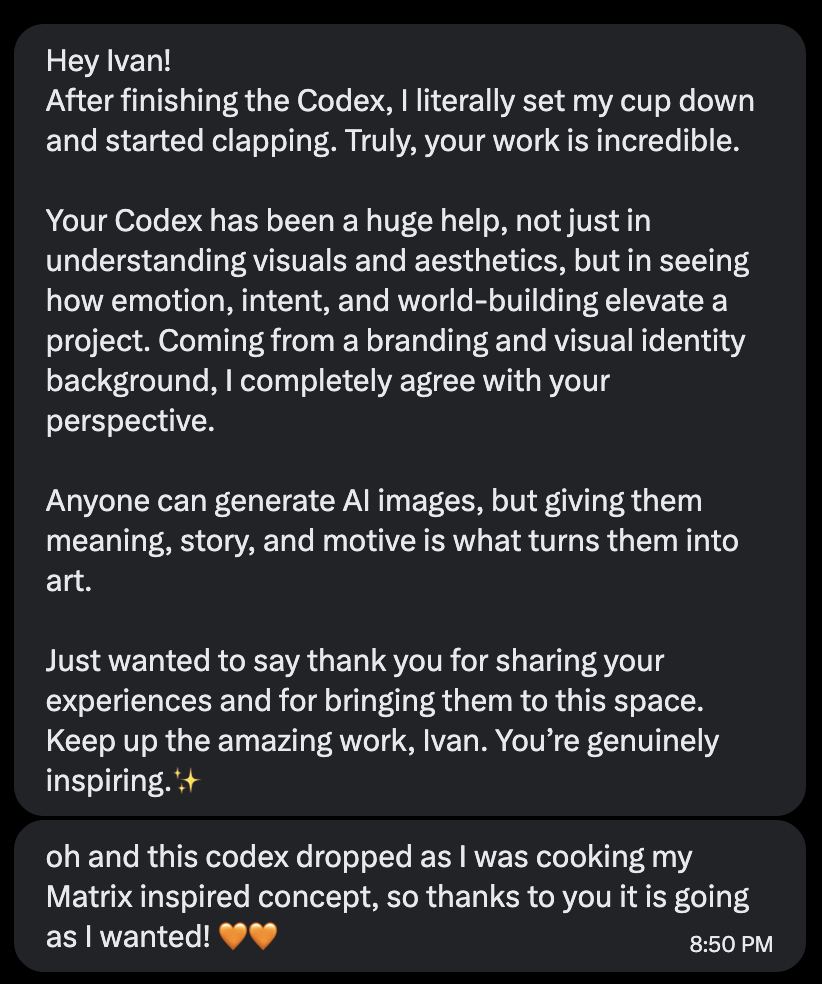
First of all, let me thank everyone who has supported me along the way. The World Building Codex was a massive personal success. The numbers, the new subscribers, and the feedback have given me a strong reason to push forward and be more consistent with this newsletter. Here is an example from X user OAK
If you haven't downloaded it yet, you can find it here.
My goal from now on is to write longer-format pieces based on topics I want to explore. Recently, amidst all the excitement of the Codex launch, I've been thinking a lot about the topic of Taste.
The Consistency Problem
There is a consistency problem I see everywhere right now—including in my own work—and that is the lack of visual coherence across time.
It is too easy to fall into the "Slot Machine" trap. If I type "a random image" into Midjourney and attach a cool --sref code, I can generate 100 really cool images. I can select the best 10, post them online, and get a few clicks.
This is fine. But you can only milk a style for so long before you run out of ideas.
Even with the new style generators that help you "lock a vibe," the problem persists. People find a shiny object, post it, get the dopamine hit, and move on to the next shiny object.
This is why AI gets a lot of hate. It encourages this pattern of shallow creation. But you need to understand: What are you actually putting into the craft to raise the value you give to your audience?
Consistency even in small amount allows you to:
- Help you audience understand you.
- Recognize your style in social media's timeline.
- Deliver a message that helps elevate your audience.
Saying Something New
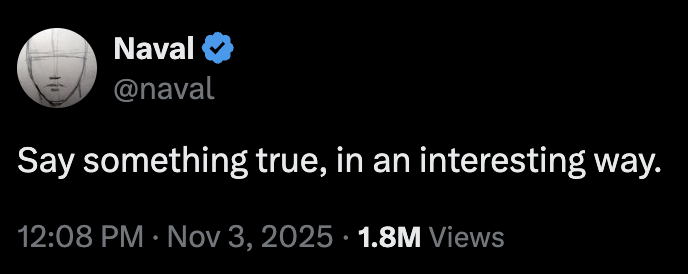
You need to bring something to the table. I created my own definition of art very early on: Art is bringing something new to the world. A new technique, a new point of view, a new aesthetic. It boils down to knowledge creation.
The question burning at the back of your head every time you deliver a piece should be: "Am I creating a story? A theme? A feeling?"/ "Am I bringing something new that the world has never seen?"
Wrong ideas are algo good ideas, they are visual conjectures that will be tested with the market (your audience) and validated in the marketplace of ideas.
Naval has a rule: "Say something new in an interesting way."
To do that, to actually stop scrolling and make someone question their beliefs or their reality, you need to master a much bigger topic. You need Taste.
Defining the Undefinable
As I write this, I'm tempted to start by saying I don't know what taste is. It is one of those things where I am almost positive one either has it or they don't. Just because I am a "creative" I am confident I have great taste, I'm ALWAYS proven wrong.
Is taste money? Money can certainly help you experiment more and make more mistakes. Or Is it the "Anti-Taste" of punk rock, which used a lot of creative constrains and messaging to communicate a position. I sometimes think on the irony of the Dumb and Dumber suits. I dress in all black because it's easy and I like it. Does that make me boring, or does it make me focused? Anyways..
Here is the definition I have settled on:
Taste is the iteration of aesthetics to achieve visual coherence.
It is the ability to arrange and re-arrange until we find harmony. It is the mastery of nuances.
But more than anything, Taste is the act of Discarding.
The Library (How to Get It)
Taste isn't magic; it is developed. But it requires work. It requires a Library.
I've talked about this before—your output is capped by your input. You need to consume high-quality references to understand high-quality decisions. You need to decode reality. Why are flowers beautiful? Why does this composition feel right?
GenAI is actually the perfect gym for this. It allows you to practice Hypercuration. You can iterate, refine, and discard at the speed of thought. You can fail 1,000 times in an hour to find the one image that works.
But this is just the technical side. The real power of taste is what it does to the rest of your life.
The Elevation Argument
This is the core of it all.
Taste is not just about making pretty pictures. Taste is a standard for your reality.
Once you begin to exercise taste—once you start identifying harmony and visual coherence—you can't turn it off. It starts to bleed into everything else. This is the Sense of Elevation.
When you become aware of the quality of your decisions in your work, you start to demand that same quality in your life.
- You stop tolerating the "non-aesthetic" in your habits.
- You stop accepting mediocrity in your environment.
- You start curating your partners and collaborators with the same rigor you curate your portfolio.
You realize that "Good Enough" is actually toxic.
This is how you future-proof yourself. We are entering an age of infinite generation. AI can produce "average" work for free, forever.
Human Judgment is the differentiating factor.
The only thing that separates you from the machine is the quality of your decisions. Taste is the filter that ensures you are not just adding to the noise, but creating value.
> When you elevate your taste, you elevate your life. You build an immune system against low-quality choices, bad partnerships, and shiny objects.
Go build your library.