LOG 015: The Floor Ate the Ceiling
AI quality baselines are rising faster than creators can adapt. Why sharper thinking, not more output, is the only skill that scales with speed.
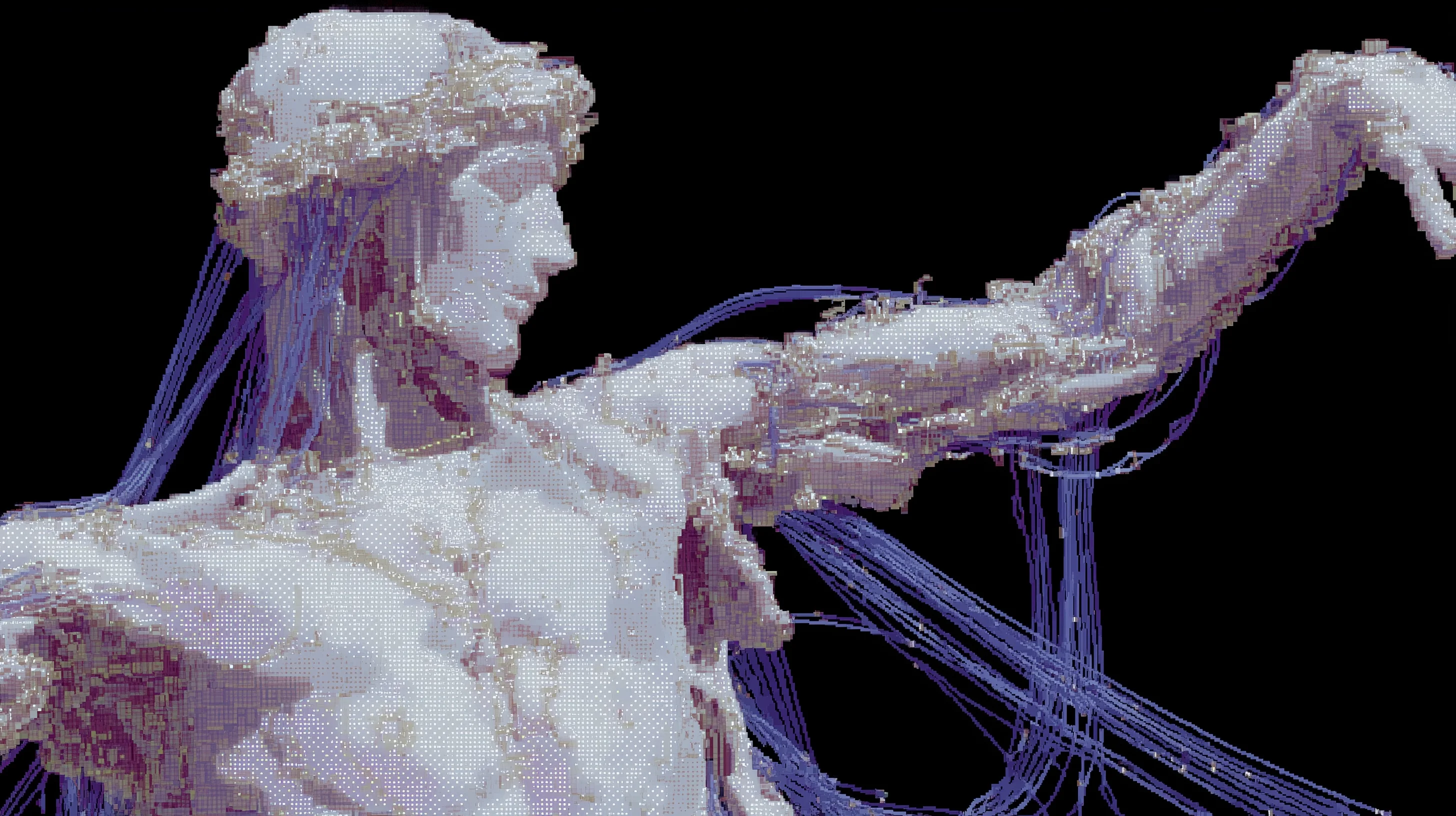
The minimum viable quality for AI content in January would not pass as a draft today. That is not a complaint. It is a measurement. And if you have been paying attention, you already feel it in your chest every time you open your timeline. Something lands that would have melted your brain six months ago. You look at it, nod, and keep scrolling. Not because it is bad. Because it is now the floor.
> The ceiling became the baseline. And the baseline is climbing faster than any individual can track.
This is the thing nobody is saying out loud: we are not struggling with the tools. The tools are extraordinary. We are struggling with ourselves.
The human is now the bottleneck.
Not in skill. Not in taste. In processing speed. In the sheer biological inability to absorb, evaluate, and respond to the volume of breakthroughs hitting the feed every single week.
And if you are good at what you do, you already know the cruel twist. You do not get rewarded with rest. You get rewarded with more.
Excellence Is Now Punished With Responsibility
I need to be honest about where I am right now.
I spent months of my free time building style reference libraries. Curating aesthetic systems. Documenting workflows. I published three volumes of the Codex. I built an audience around a methodology that turned raw AI generations into coherent worlds. That work got traction. Real traction. It opened doors, started conversations with people I deeply respect, created momentum that felt like compound interest.
And right now, I am watching parts of that work become obsolete in real time.
Techniques I refined over weeks are now default features in the next model update.
Workflows I documented are being replaced by single prompts.
Courses being built around specific tools are dissolving before they ship because a new release does it automatically.
The style references, the expansion pipelines, the curation systems. The ground they were built on keeps shifting.
And here is the part that nobody in the "adapt or die" conversation talks about. When you raise your bar, other people notice. They hand you more.
More projects. More expectations. More responsibility. You become the person who "gets it," and suddenly you are carrying the weight for an entire community, an entire audience that expects you to keep raising the bar while everyone around you coasts on the average.
> AI accelerated the gap between the people who push and the people who cruise.
The distance used to widen over years. Now it widens over weeks. And the people pushing hardest are also the ones most paralyzed, because the tools rewarded their ambition with infinite scope and zero recovery time.
The typical advice here is "you need to adapt." I have heard it a thousand times. It is lazy. It says nothing. Adapt how? Adapt to what? The landscape shifts before you finish adapting to the last shift. That advice belongs to a world where change happened once a decade, not once a Tuesday.
So I am not going to give you that advice.
I am going to tell you what I am telling myself.
The Overwhelm Is Not New. The Fix Has Always Been the Same.
People have been declaring the end of human capacity since the printing press. Too many books. Too many newspapers. Too many channels. Too much internet. The diagnosis is always the same: we were not designed for this volume. And the diagnosis is always technically correct and completely useless.
We were not "designed" for any of the things that define modern life. Writing. Mathematics. Architecture. Music theory. None of it was in the original spec. Humans transcend their biological wiring every single day before breakfast. That is the entire point of being human. Biology set the starting conditions. It did not set the ceiling.
The people who survived every previous information explosion were not the ones who processed the most. They were the ones who learned to think more clearly within the noise. They figured out what to ignore, which turned out to be most of it, and aimed their focus at the narrow slice that actually mattered.
That is the only skill that scales with speed. Not more hours. Not more output. Sharper thinking. The ability to look at a hundred signals and know instantly which three are real.
> The overwhelm you are feeling right now is not evidence that the game is unwinnable. It is evidence that you have not yet built the reasoning habits to navigate it. And that is a solvable problem.
The 15-Second Shelf Life
Every new tool that drops follows the same arc. Breathless announcement. Timeline flooded with demo reels. Everyone loses their minds for about fifteen seconds. Then the dust settles. The outputs start looking the same. The defaults become obvious. The "wow" fades into "ok, now what?"
And then silence. Because the tool did its party trick, but nobody built anything lasting with it.
This is the part that matters: these tools need you more than you need them.
Every new model that ships needs proof. Not demo reels from the company. Not cherry-picked outputs from the research team. It needs real creators making real work that shows what the tool can actually do in the hands of someone with vision. The tool provides the capability. You provide the credibility.
Think about what that means. You are not a passive consumer of these releases.
You are the battlefield.
> Every tool company is fighting for attention, for adoption, for the creator who will make their model look like the future. That is leverage. Massive leverage.
And most creators are not using it because they are too busy being intimidated by the tool instead of recognizing that the tool is auditioning for them.
The technology is turning creatives into mouthpieces. That can work against you if you are passive, just another person reposting demo clips. Or it can work for you if you recognize that being the person who makes a new tool look incredible is one of the most powerful positions in this entire ecosystem.
Stop mourning your old workflow. The old workflow was scaffolding. It did its job. Now there is new scaffolding, and it is faster and more powerful, and it needs someone to build something extraordinary on top of it.
That someone should be you.
The Real Skill Is Asking the Intelligence What You Actually Want
We are entering an era where the quality of your output is directly proportional to the quality of your input to the intelligence. Not your technical skill. Not your speed. Your ability to articulate what you actually want.
Most people (myself included) prompt like they are ordering fast food. "Give me a cool image." "Make it cinematic." "Add drama." Vague inputs produce average outputs. And average, as we just established, is now invisible.
The creators pulling ahead are the ones who learned to think precisely before they touch the tool. They know the emotional temperature of the scene. They know the narrative function of the composition. They know what the light is doing and why. They arrive at the prompt with a complete vision and use the tool to extract it.
This is directing. This has always been directing. The tool just made it obvious that directing was always the hard part, not the rendering.
The gap between a vague request and a precise one is about to become the widest competitive advantage in the creative landscape. The tools will just keep getting better at execution.
The Great Wrapping
Something deeper is happening underneath all of this chaos.
Language models are doing something unprecedented: they are cataloging every creative pattern humanity has ever produced. Every composition rule. Every narrative structure. Every color theory principle. Every genre convention. Every stylistic trick. All of it, being surfaced, organized, and made predictable.
This sounds terrifying if you think your value is in knowing those patterns.
But think about what comes after.
For centuries, creative knowledge has been scattered. Lost in entropy. Buried in obscure references, forgotten techniques, oral traditions that died with their practitioners. We have been swimming in a sea of accumulated creative intelligence that was too vast and too disorganized for any single person to comprehend.
The models are wrapping it up. All of it. Every pattern, every convention, every technique that ever worked, being made explicit and accessible. And the moment all of that is visible, something extraordinary happens: we can finally leave it behind.
When you can see every pattern clearly, you can see what lies beyond them.
This is the clearing of the table.
The old patterns are being archived so that humans can stop unconsciously repeating them and start consciously transcending them. There will come a point where even synthetic data, the models training on their own outputs, will not be enough to generate genuinely new ideas. That is where human creativity becomes essential again. Not as a source of more patterns, but as the only force capable of breaking them.
We are approaching the moment where everything that has been done is known. And the only valuable creative act is something that has never been done before.
Suck It Up and Explode
I am watching my own momentum shift underneath me. Work that got me here is losing its edge. The specific techniques are expiring. The exact processes are being eaten by the next update. And I can either sit with that feeling and let it freeze me, or I can treat it as the most aggressive invitation to level up that I have ever received.
I am choosing the second one.
The floor rose and how Jocko would say...good. That means the people who were coasting on mediocre output with good tools are now exposed. The floor rising is the best thing that could happen to anyone who was already pushing, because it eliminated the noise below them. The people who were faking it with default settings and trending styles just lost their cover.
Every new tool that makes the old workflow obsolete also makes a new kind of work possible that did not exist yesterday. This is not about adapting.
The models are wrapping up the past. That is their job. Your job is to be the thing they cannot wrap. The irreducible point of view. The specific knowledge that could not have come from anywhere else. And then to use every single tool at your disposal, old and new, to make that point of view impossible to ignore.
The door is open. The same door it has always been.