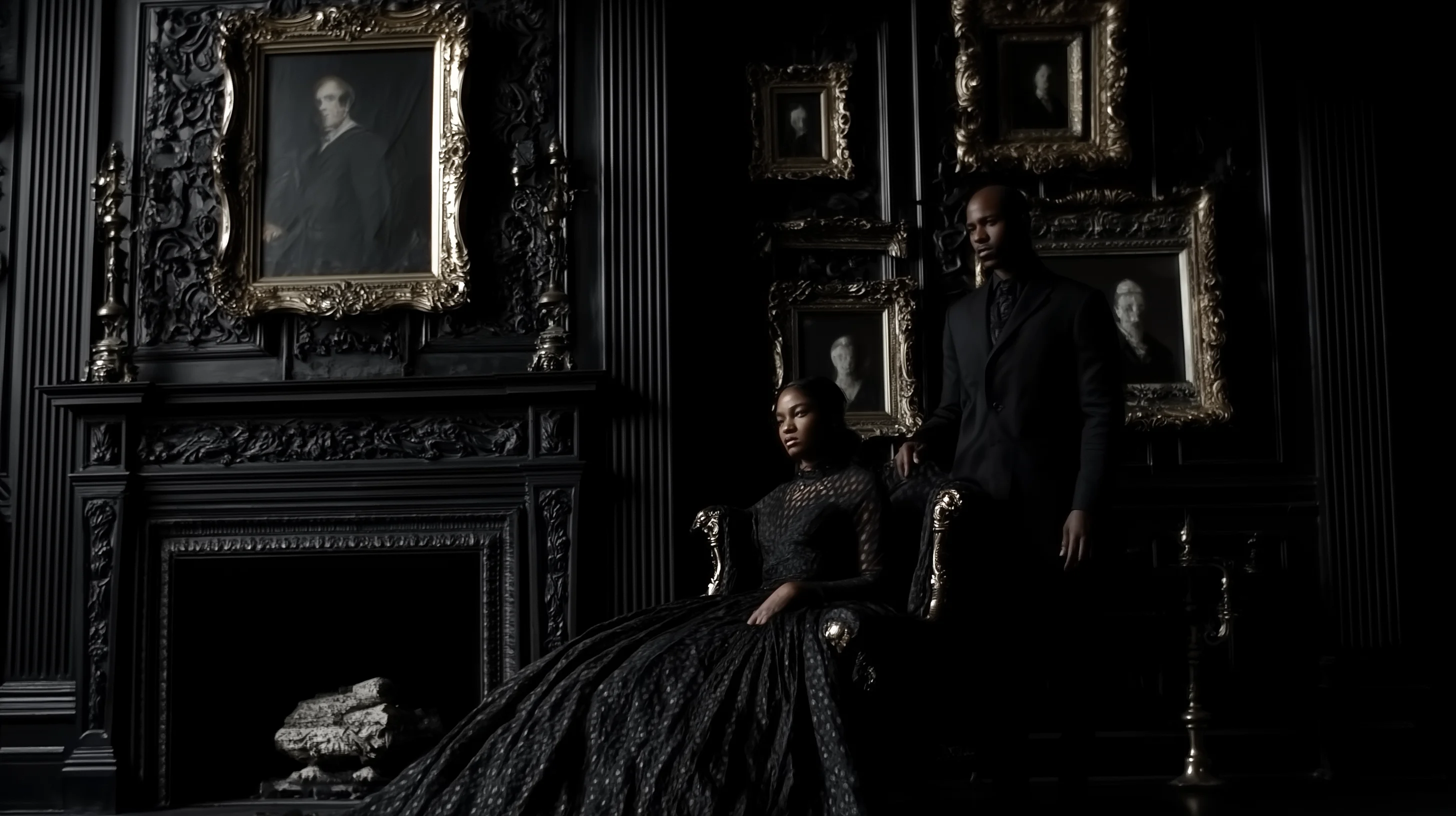
You are not telling a story in a still image. You are implying that one exists.
By Ivan Flugelman · 11 min read · Updated 2026-08-18
Story in world building is not plot. You are not illustrating events. You are implying that events have occurred.
The thesis is timeless, always true in this world. Story is what happens under the thesis’s governance, and it is what turns a coherent look into a place with a history.
The mechanism is simpler than it sounds: every image sits at a point in time relative to something that happened.
Before, during, after
Every frame is in one of three temporal states. Choosing consciously is most of the craft.
Before. Anticipation. Clean surfaces, intact structures, held breath. An empty room before the meeting. A pristine landscape before the storm. The tension of not yet. This is Kubrick’s preferred territory: the dread of what is coming.
During. The event. Motion, disruption, transformation happening now. Dust clouds from a collapse, light pouring through a newly opened door, a figure mid-stride. This is the hardest state in a still image because it requires implying motion inside a frozen moment.
After. Evidence. Decay, aftermath, the memory of what occurred. Ruins, stains, abandoned objects, spaces that were once full. Visually the richest state, because it implies the entire history that led here. Tarkovsky lives almost entirely in this one.
Most people default to during, because it seems like the most interesting moment. It is usually the weakest, because a still cannot deliver motion and ends up looking staged.
Before and after do the work. Both are quiet. Both make the viewer construct the event themselves, which is a stronger effect than showing it.
The event is not the story. The evidence is the story.
Narrative through environment
You do not need a character to carry story. Environments carry it more reliably, because they cannot overact.
A crumbling wall tells a story of time and neglect.
A pristine surface tells a story of control and maintenance.
Fog tells a story of uncertainty or transformation.
Light breaking through darkness tells a story of hope, revelation, or exposure.
A chair facing a window tells a story of waiting.
A door left ajar tells a story of departure, or invitation.
Water stains on a ceiling tell a story of decay from above.
A single plant growing through concrete tells a story of persistence.
This is the highest-yield list in the fundamentals for anyone whose images look beautiful and inert. One deliberate piece of evidence in frame changes an image from a render into a scene.
The three beats
For a set of images, or for a short sequence, three beats are enough. Not a plot. A shape.
Establishment. Where are we, what is the mood, what are the rules of this place? The first image, or the first three to five seconds.
Disruption. Something changes. A glance, a light shift, motion beginning, a door opening, a shadow moving. The middle.
Resolution. Not an answer, a feeling. The viewer is left with a question or an emotion. The final image, or the final moment.
What this looks like in practice
A world whose thesis is “nature won, but the geometry of ambition still scars the landscape.”
Before, establishment. A vast green landscape, rolling hills under dense vegetation. But the hills are too regular, too geometric. They are the shapes of buried buildings. The world is quiet, nature has won, and something underneath persists.
During, disruption. A section of hillside has collapsed, revealing a wall of glass and steel beneath the soil and roots. The exposed surface is still intact, still reflective. The building did not decay, it was buried. This changes what the first image meant.
After, resolution. A wider view showing the exposed face alongside the intact hillsides, with small figures standing near the wall. They are not excavating. They are just looking. The resolution is a question: will they dig, or let it be covered again?
The “after” frame, written as evidence
a wall of intact glass and steel exposed in a collapsed green hillside, roots hanging over the reflective surface, soil still fresh at the break, three small figures standing at a distance simply looking, overcast diffused light, moderate haze, wide shot, no excavation equipment --ar 16:9
Common mistakes
Illustrating a plot. World building implies history, and an image that spells out an event stops being a doorway.
Defaulting to during. Motion in a still reads as a frozen pose more often than as action.
Putting story only in characters. Faces overact. Floors do not.
Adding evidence that contradicts the thesis. A crumbling wall in a world of total maintenance is a plot hole, not texture.
Practice
Take one location and generate it three times: before, during, after. Keep everything else identical.
Then build the three-beat set for your world, and write one sentence for what each beat is meant to make the viewer ask.
Finally, take your most beautiful inert image and add one piece of environmental evidence. Compare the two.
The method is free. The practice is the Academy.
Everything above is the whole method. The World Building Academy is the part a page cannot carry: the fundamentals on video, a full world built end to end, the Render Stack, motion, editing, and the case studies. Or start with the free Codex.