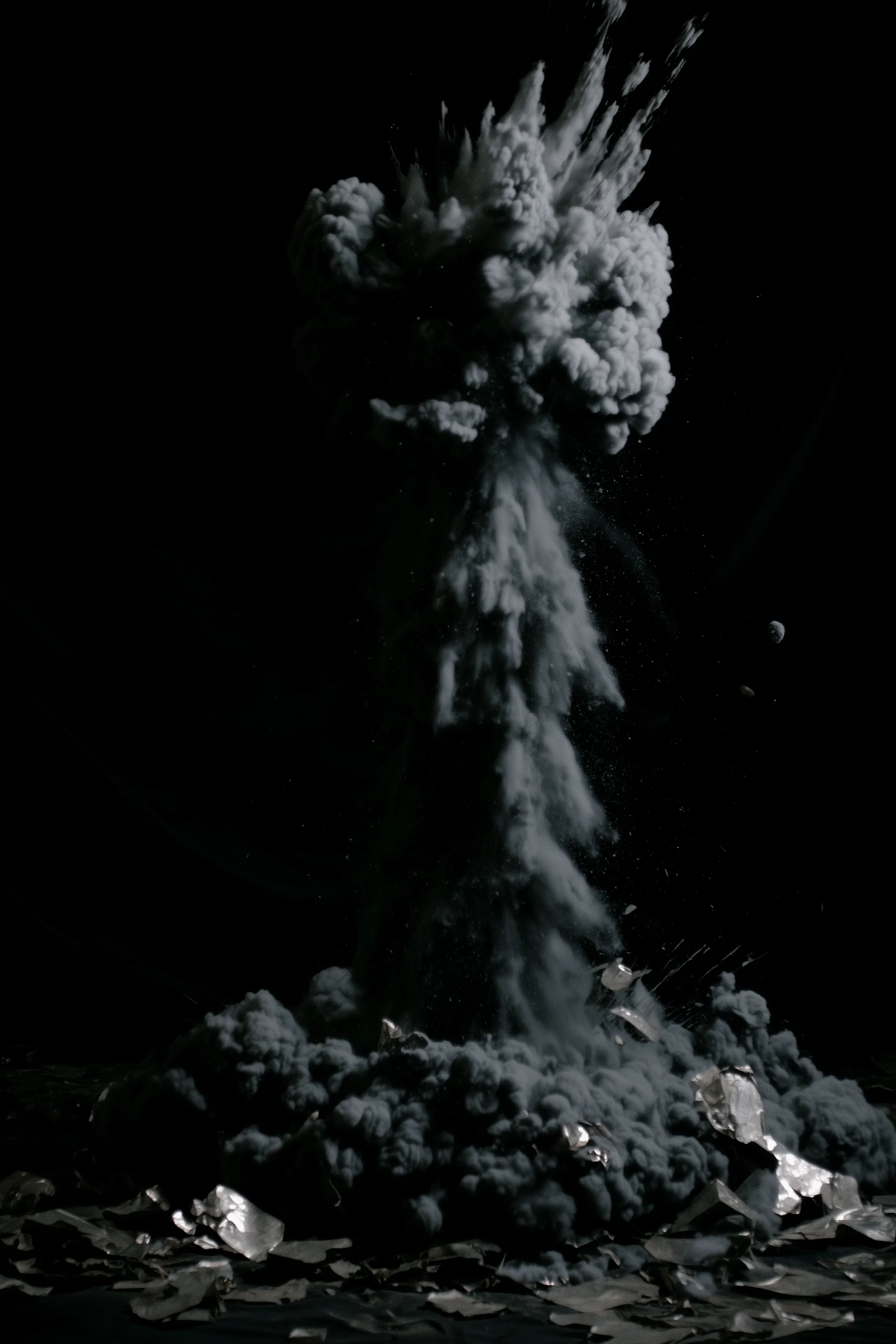
Atmosphere: the air between the camera and the subject
The layer almost everyone forgets, and the fastest way to make a world feel like a place.
By Ivan Flugelman · 11 min read · Updated 2026-08-18
Atmosphere is the physical condition of the air, the light and the weather at the moment the image exists.
It is the layer that separates a rendered object from an inhabited place, and it is the one most people never specify, which is why so much AI work looks like a well-lit product shot of a fictional thing.
Tone says the world feels melancholy. Atmosphere says the air is thick with fog and the light is gray-blue and fading.
The five environmental layers
Specify these five and almost any subject becomes a place. Skip them and the model supplies its defaults, which are clean air, midday light and infinite visibility.
Light direction and quality. Where is it coming from? Hard with defined shadows, or soft and diffused? Warm or cool? One source or many? This is the single most impactful attribute in the frame.
Air quality. What is between the camera and the subject? Fog, rain, dust caught in beams, smoke, haze, ash, pollen, or clean nothing? This is the layer most people forget, and the one that reads most strongly as reality.
Time of day. Dawn is hope and vulnerability, the world has not decided what it is yet. Noon is exposure and harshness, nowhere to hide. Golden hour is nostalgia, the world performing its best version of itself. Blue hour is transition and melancholy. Night is concealment and artificial control.
Weather. Dry, wet, stormy, still, windy, frozen? Weather changes how every surface behaves. Wet concrete reflects. Dry stone absorbs. Frost transforms. Wind moves fabric, hair and vegetation.
Depth. How far can you see? Infinite visibility feels open and exposed. Fog cutting off at twenty meters feels claustrophobic and secretive. Moderate haze at two hundred meters gives scale without overwhelming.
Air quality deserves the extra attention. It is the difference between a light source and a visible beam, between a distant building and a distant building you believe is far away. Almost every image that feels cinematic has something in the air.
The fastest upgrade to most people’s work is deciding what is in the air.
The golden hour trap
Golden hour is the model’s favorite gift and it will hand it to you unrequested, forever, because it flatters everything.
That is exactly the problem. A world where every image is golden hour has no time. It has one perpetual flattering moment, which reads as a stock aesthetic rather than a place with a day in it.
Choose your world’s default hour deliberately, and let it be an unflattering one if the thesis calls for it. Noon is brutal and honest. Blue hour is uncertain. Overcast is the most underrated light in generative work, because it removes the drama and forces the world to be interesting on its own terms.
How atmosphere connects
Tone sets the register. Atmosphere is the physical means of producing it.
Visual language defines colors and materials. Atmosphere defines how they look under specific conditions. A red wall in fog is a different red wall in sunlight.
Composition defines where things are. Atmosphere defines how clearly you can see them, selectively revealing and concealing.
Scale is dramatically affected by atmosphere. A building at five hundred meters in clear air looks close. The same building in dense fog looks impossibly distant.
What this looks like in practice
The memory world, specified as atmosphere:
Light: soft, directionless, as if the air itself glows faintly, because memories have no single source.
Air quality: fine particulate haze, like motes of dust in a beam.
Time of day: perpetual late afternoon, when shadows are long and the mind turns to reflection.
Weather: still, no wind. Memory does not move.
Depth: moderate. Distant things are visible but softened, like half-forgotten details.
Atmosphere block, reusable across prompts
soft directionless light with no single source, fine particulate haze suspended in the air, perpetual late afternoon, completely still with no wind, moderate depth visibility with distant elements softened, sepia and fog-white cast
Common mistakes
Leaving the air empty. Clean air is a choice that should be made on purpose, not by omission.
Defaulting to golden hour in every frame. A world with one hour has no time in it.
Using fog as a fix for weak composition. Fog hides problems in stills and exposes them the moment anything moves.
Changing weather per image for variety. Weather is a world condition, and a world whose weather resets every frame has no continuity.
Practice
Write your five layers as one atmosphere block you paste into every prompt, then generate five unrelated subjects with it attached.
Deliberately generate your world at its least flattering hour. If it collapses, the world was depending on light rather than structure.
Then generate the same location at two different times of day and check that it still reads as the same location.
The method is free. The practice is the Academy.
Everything above is the whole method. The World Building Academy is the part a page cannot carry: the fundamentals on video, a full world built end to end, the Render Stack, motion, editing, and the case studies. Or start with the free Codex.