The Director's Eye: 13 Filmmaking Principles That Fix AI Video
AI video doesn't have a quality problem — it has a direction problem. The 13 principles I use to build coherent cinematic worlds with AI: thesis, palette logic, atmosphere, editing ratios, signature.
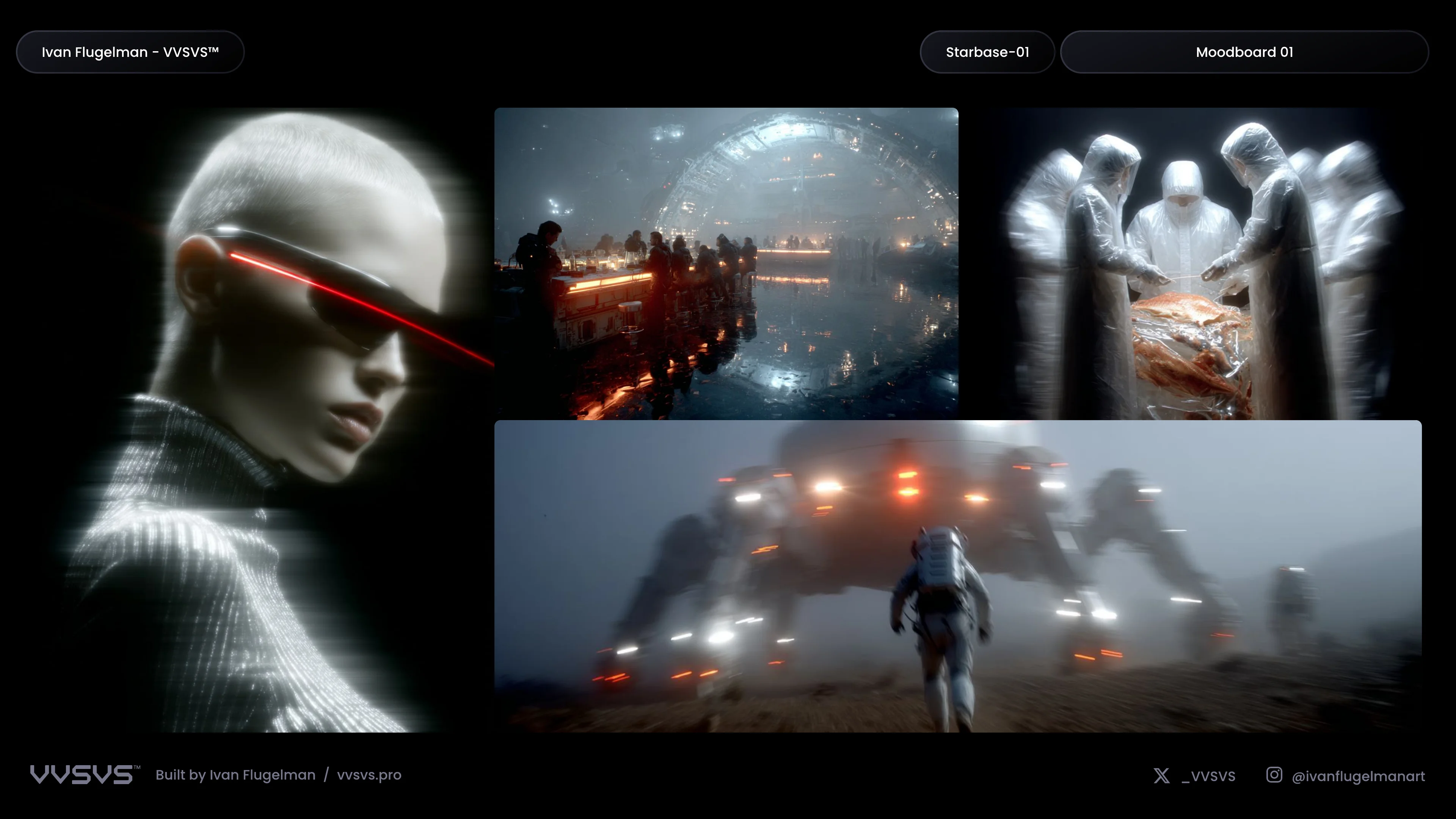
AI video doesn't have a quality problem. It has a direction problem.
The models now out-render most film school graduates. Every feed is full of technically stunning clips — perfect light, perfect textures, perfect motion — that evaporate from memory three seconds after they end. Gorgeous, and it could be anyone's gorgeous. There's no world underneath, no point of view, no hand behind the frame.
I spent twenty years in the creative industry and built visual worlds for brands like BMW, Porsche and Riot Games. Here's the uncomfortable truth the tools exposed: the decisions were always the work. The rendering — human crew or diffusion model — was always the cheap part.
Last year I put those decisions into a system and stress-tested it by building one world, Starbase-01, from a blank page to a finished 60-second cinematic trailer — every frame from the same hand, or so it reads. These are the thirteen principles that system runs on, in the order I actually use them: Foundation (what your world is), Craft (what it looks like), Direction (how it behaves over time). Each ends with the move you can make today.
Foundation
1. Thesis
Every world that holds together is an argument. Not a theme, not a vibe — a position. Something your world argues for. It's the filter every future decision passes through, and it's why the great directors' frames are recognizable with the sound off: Kubrick never shot a frame that wasn't making his film's argument.
Starbase-01's thesis is one line: the sacred outlives the machine that built it. Every image either serves that sentence or dies in the edit.
Direct it: Before you generate anything, write the one sentence your world argues. If a generated image doesn't serve the sentence, it doesn't enter the world — no matter how good it looks.
2. Internal Logic
The invisible history that gives weight to everything the viewer sees. It doesn't need to be explained — it needs to be felt. It's the reason the ship in Alien still works: it isn't a spaceship, it's a truck, and every greasy corridor knows it.
For Starbase-01 I wrote rules the viewer will never read: who holds power (a priesthood, not an army), what's scarce (heat), what's sacred (the old machines), what broke (the reason the fog never lifts). None of it appears on screen. All of it appears in the images.
Direct it: Five rules, written down, before frame one — power, scarcity, fear, history, taboo. Generate only inside them. The audience can't read your rules, but they can smell their absence.
3. Archetypes
The recurring figures, symbols and patterns that populate your world — its vocabulary. Starbase-01 runs on a handful: crew silhouettes dwarfed by structures, three castes you can read by dress (Priest, Ruling, Court), chrome that behaves like flesh, one incandescent light source cutting fog.
Repetition is the mechanism. The first time a viewer sees the pattern, it's interesting. The fifth time, it's a signature. The twentieth time, it's a world. That's not a metaphor — it's how recognition works in the brain: repeated pattern becomes expectation, expectation becomes immersion.
And specificity is the power source. "Dark colors" is not an archetype. "Charcoal and dried blood against matte concrete" is an archetype. Generic archetypes produce generic worlds.
Direct it: Define five archetypes — never more than seven — and make each brutally specific. Then repeat them until they stop being choices and start being facts.
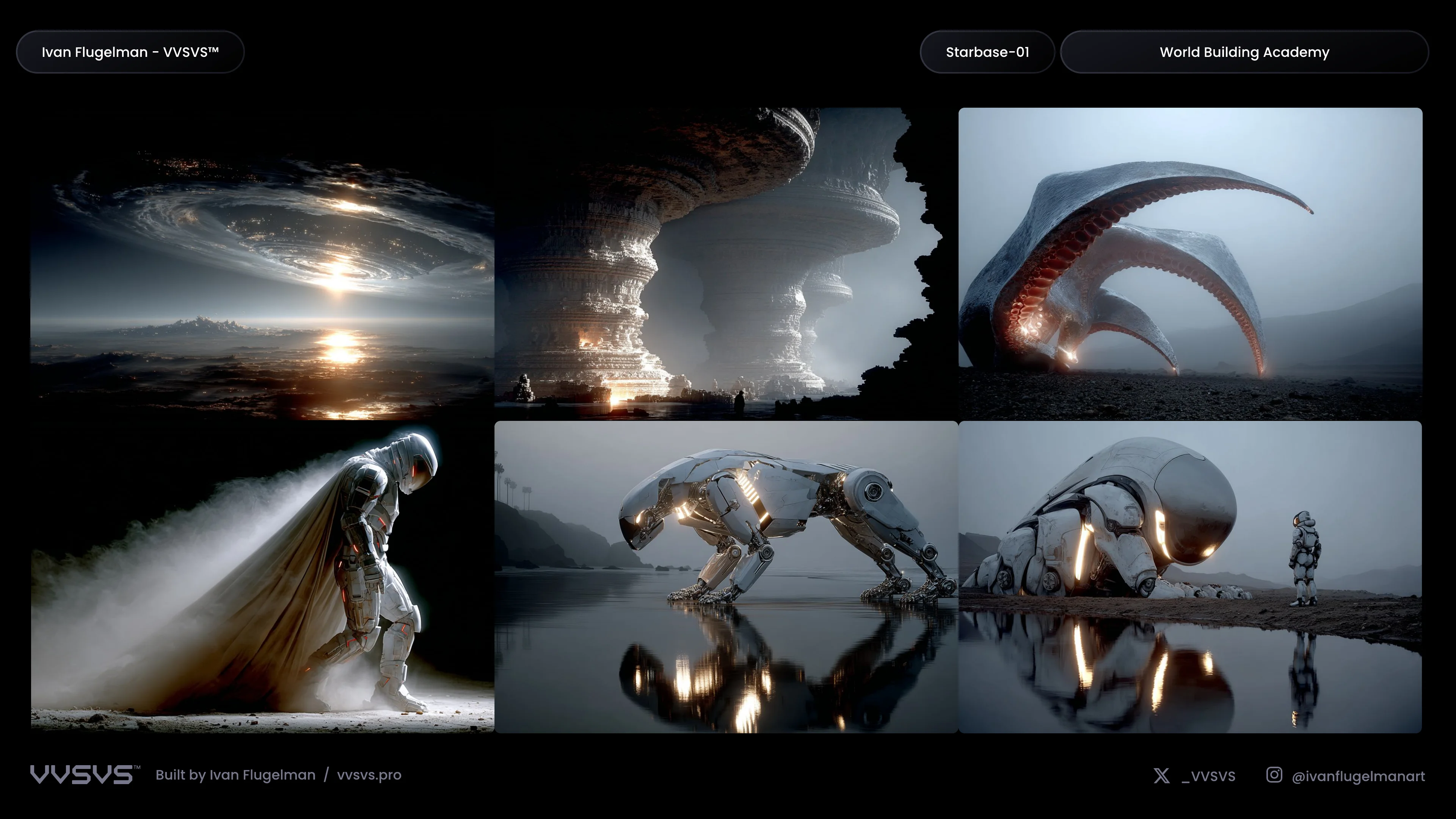
This shift — from rendering prompts to directing worlds — is the core of the whole method. Here's the full lesson on it, free, straight from the Academy:
Craft
4. Visual Language — the 60/30/10 rule
Every coherent world runs a dominant palette of no more than three colors. The dominant — 60% of every frame — is the world's signature: the green of The Matrix, the burnt orange of Fury Road. The secondary — 30% — is what the dominant plays against. The accent — 10% — is what the eye seeks; used sparingly, for meaning.
Starbase-01: fog-white dominant, cold steel secondary, one burning incandescent accent. Three colors, hundreds of frames, zero drift.
Then do the same for materials — this is where most world builders stop too early. Chrome + glass reads sterile future. Concrete + rust reads industrial decay. Bone + gold reads sacred violence. Materials are emotional grammar.
Direct it: Lock your three colors and your material pair into every prompt as a fixed suffix. Kill any output where the palette drifts — a warm accent in a cold world is a continuity error, not a variation.
5. Composition
How you direct the eye inside a single frame. The most awarded cinematographer alive, Roger Deakins, describes his method with almost embarrassing simplicity: one clear subject, nothing in the frame that doesn't serve it.
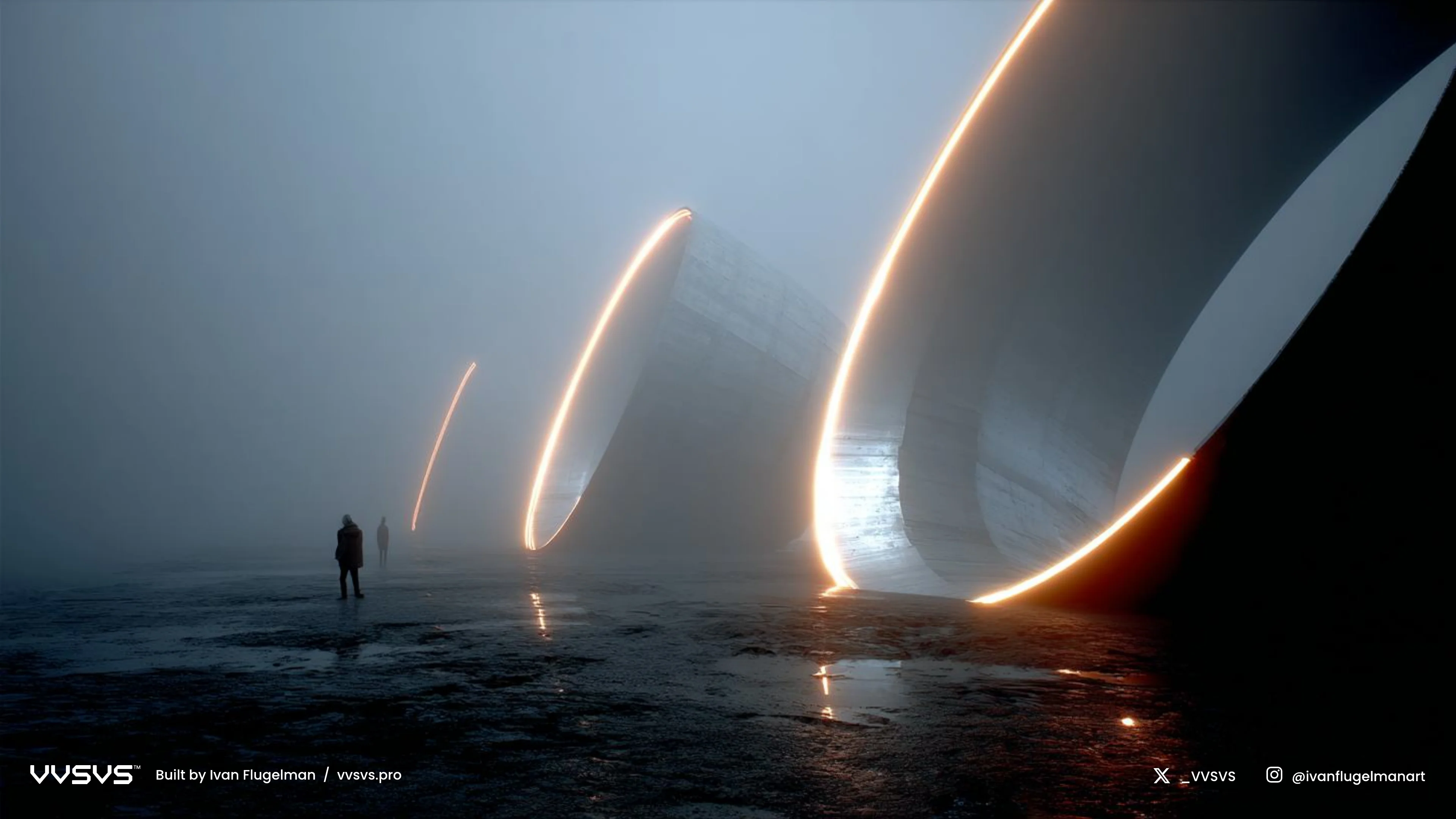
Your default framing is part of your world's identity. Starbase-01 defaults to vast negative space pressing down on small figures — the composition itself repeats the thesis. Pick your own default and the frames start feeling shot instead of found.
Direct it: Choose one composition archetype — centered, thirds, symmetrical, tiny-figure-vast-space — and make it your world's default in every wide shot.
6. Tone
The emotional register that persists no matter what the subject is. Tone is the first thing that shatters in AI work, because every generation is a fresh roll of the dice: one clip yearns, the next one poses.
Direct it: Name your world's register in two words — Starbase-01 runs on sacred dread — and test every output against it. Subject changes freely. Register never.
7. Atmosphere
The breath of the world: light, weather, depth, hour. The environmental layer that turns a flat image into a place you can smell. Think of what rain does in Stalker — the weather is the world.
Direct it: Give your world a fixed climate and a fixed hour. Not "moody lighting" — "forty minutes after rain, overcast, light through wet air." Atmosphere is a continuity decision, and it's the single cheapest way to make separate generations feel like one location.
8. Scale
How big things feel — and it's set by relationship, not size. A doorway three humans tall tells you who built the world and whether it was built for you. Starbase-01 leans oppressive: the crew exist to be dwarfed, because the thesis demands machines that outgrew their makers.
Direct it: Decide your world's scale bias — oppressive, intimate, or heroic — and enforce the figure-to-environment ratio in every wide shot. Inconsistent scale is why AI "cities" feel like toy sets.
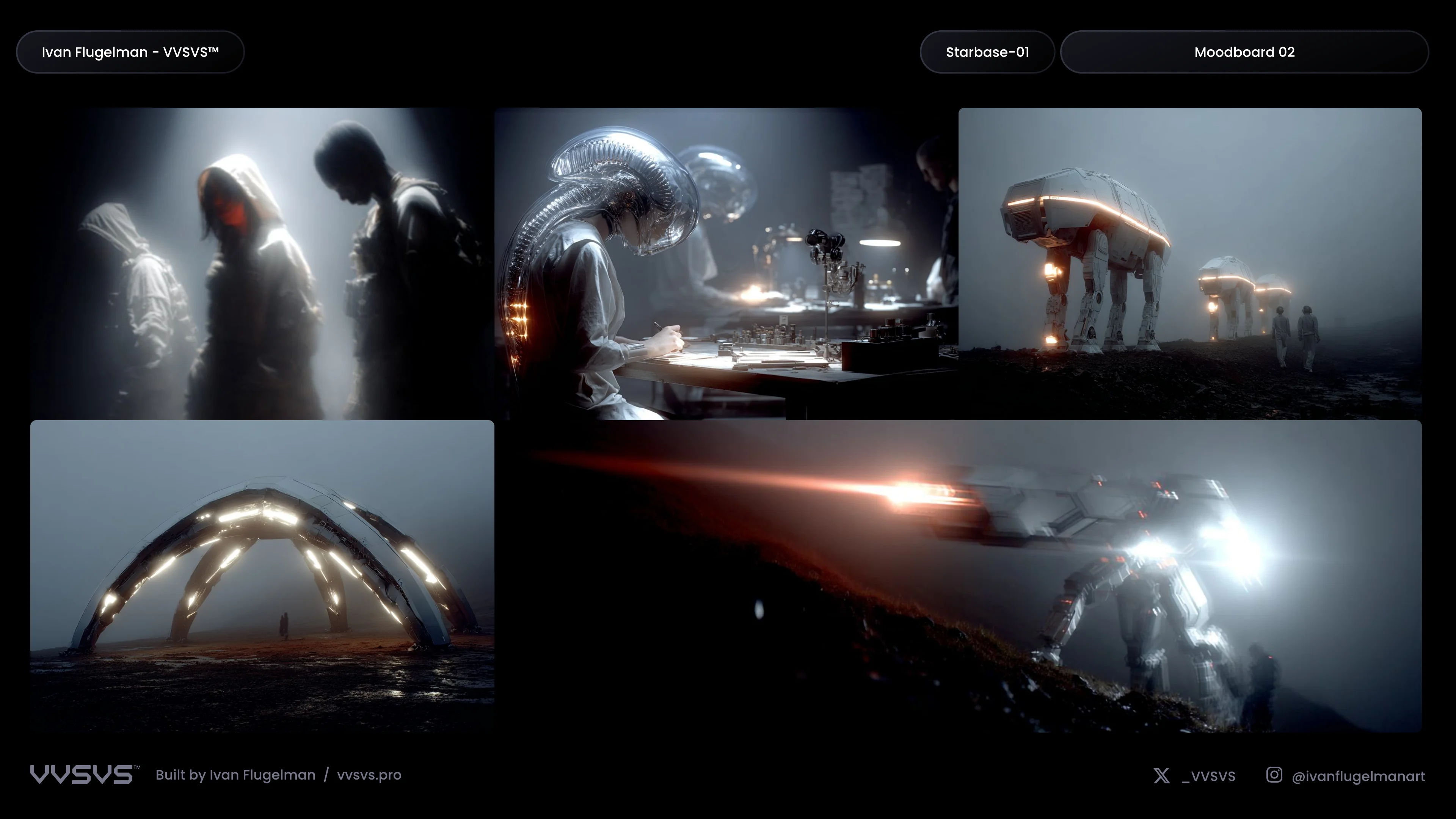
Craft is also where the tools stop being scary. Here's a full technical lesson from Module 3 — building an aesthetic deliberately with Midjourney's Style Creator, refining through selection until the model converges on your taste:
Direction
9. Story
The frame is never the whole story — meaning comes from what happened before the image and what's about to happen after it. Hitchcock's bomb under the table. In a still or a five-second clip, story is implied movement: a meal half-eaten, a door forced and re-barred, scorch marks above a shrine that someone recently cleaned.
Direct it: Every image answers one question — what just happened here? If the honest answer is "nothing, it's just pretty," cut it. Pretty is the entry fee, not the work.
10. Pacing
The rhythm of revelation: what you show first, what you withhold, when the withheld thing lands. It exists in a 60-second AI trailer exactly as it does in a feature. The Starbase-01 trailer holds its best image until second 47 — everything before it is permission to care.
Direct it: Sequence your outputs in acts: wide establishing → texture → character → the one image you've been saving. If your best frame comes first, you don't have a trailer — you have a screensaver followed by decline.
11. Editing
The discipline of coherence — killing outputs that don't serve the thesis, no matter how beautiful. The ratio is harsher than most people can stomach: generate 100, select 20 that are technically strong, keep 5 that belong in the world, feature 1–2 that define it. Ninety-five percent of your output should never be seen. That's not waste; that's the job. The photographers you admire shoot thousands and show dozens. The filmmakers you admire shoot hundreds of hours and release two. The ratio is the practice — ask any editor since Walter Murch.
Direct it: If you're keeping more than one in five generations, you're not editing — you're collecting. Kill palette drift, kill lighting that breaks your atmosphere, kill everything that's merely beautiful.
12. Repetition & Variation
How motifs recur with enough consistency to feel intentional and enough difference to feel alive. One detail, returning with increasing specificity: in Starbase-01 it's a hand-painted marker — barely visible on a distant wall in one image, legible in another, and finally a close-up revealing the handwriting and the care of whoever documented what was lost. One motif, three distances, compounding meaning.
Direct it: Pick one motif and plant it across your next ten outputs at three distances — background, midground, close-up. This is where worlds start to compound.
13. Signature
What makes the work unmistakably yours — the thing that persists across different worlds, different tools, different projects. You don't design it. It's like handwriting: it emerges from thousands of hours, it's recognizably yours, and it contains information about you that you didn't consciously put there.
Direct it: You can't shortcut this one, but you can accelerate it: work in worlds instead of one-offs, keep your kill-rate high, and after ten finished pieces, lay them side by side and ask what survived every world. That's yours. Protect it.
The part nobody wants to hear
Every principle above predates AI, and that's precisely the point. Prompts expire with every model update. Tricks expire. Decisions don't. The people who learn this month's model start over every quarter. The people who learn to direct just swap the tool and keep building.
This post is the map. If you want the territory:
- The World Building Codex — three free volumes, 120+ pages: the full framework these thirteen principles come from.
- Cinematique — 150+ cinematic prompt techniques, free and searchable: the shot-level vocabulary to execute all of it.
- The World Building Academy — the complete method, taught by building: I take Starbase-01 from a blank page to the finished trailer in front of you, decision by decision, and you build your own world alongside me. The two lessons embedded above are from it — and all of Module 1 is free: grab it on the Academy page and you'll be watching inside the real course player in two minutes. $250, lifetime access, every future update included.
Stop rendering prompts. Start directing.
— Ivan