← Cinematique Camera Work · Basic

Two-Shot Prompt for AI Image & Video

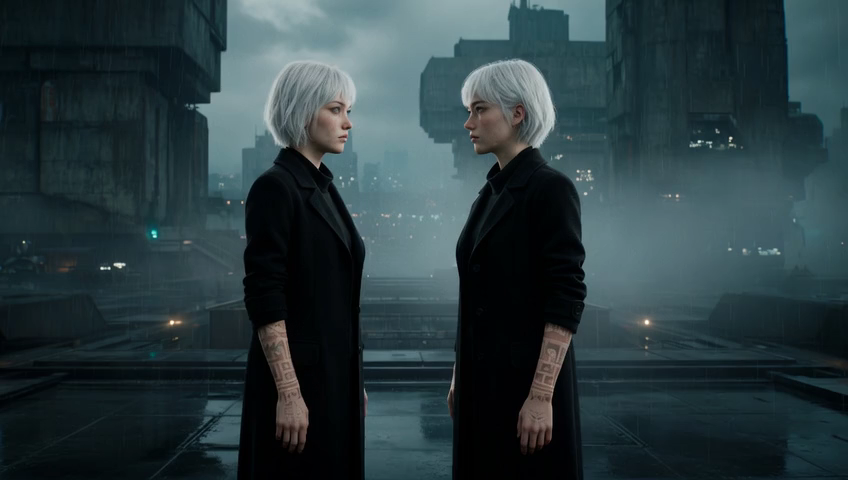
Two-Shot cinematic example

A shot framing exactly two subjects, showing their spatial and emotional relationship, essential for establishing dynamics between characters in conversation, confrontation, or intimacy. Billy Wilder was a master of the two-shot, using it in "The Apartment" and "Some Like It Hot" to capture the chemistry of his actors. Before Midnight director Richard Linklater builds entire films from two-shots of couples walking and talking, and Wong Kar-wai uses cramped two-shots in "In the Mood for Love" to convey forbidden intimacy within claustrophobic spaces.

By Ivan Flugelman · Reviewed 16 July 2026

Prompt template

Two-shot of [Subject] framed together, their bodies creating complementary angles, the space between them charged with everything said and unsaid, shot on a 50mm Summilux at f/1.4 with gentle background blur, Kodak Portra 400 color rendition with soft warm midtones, the quiet eloquence of two figures in shared space

Replace [Subject] with your own character or scene. The prompt is technology-agnostic and works as a starting point for AI image or video generators.

When to use Two-Shot

Use a two-shot when the relationship between two people matters more than either individual performance alone. Shared framing exposes attraction, alliance, rivalry, distance, and changes in who controls the space. It works for conversation, walking dialogue, confrontation, and silent intimacy. Move to singles when isolation becomes the point, or to over-the-shoulder coverage when the exchange needs more subjective pressure.

Directing the AI

Frame exactly two subjects with both faces and body angles legible. Use their spacing, height, orientation, and shared eyeline to express the relationship before dialogue begins. A normal lens and gentle background separation keep the scene intimate without erasing context. Leave the gap between them visible; it carries emotional weight. For video, choreograph who closes, crosses, or withdraws from that gap while keeping both figures inside the composition through the beat.

Common mistakes

  1. Treating both figures as independent portraits, with no eyeline, gesture, or spatial tension connecting them.
  2. Cropping one subject at an awkward edge, making the second person feel accidental rather than compositionally equal.
  3. Using background blur so heavy that the shared environment no longer contributes to their relationship.
Sources and further reading

  1. 50+ Types of Camera Shots, Angles, and Techniques — StudioBinder
  2. Types of Camera Movements in Film Explained — StudioBinder

A shot is not a world

Learn the fourteen fundamentals for building consistent characters, environments, visual logic, and stories that expand beyond one beautiful frame. Get World Building Codex 3.0 free, or explore the World Building Academy.

Related techniques

Three-Shot

A shot framing three subjects, often used to show group dynamics, alliances, or the odd-one-out tension within a trio. Sergio Leone perfected the three-shot in the climactic standoff of "The Good, the Bad and the Ugly," cycling between three armed men in a graveyard to create one of cinema's most iconic compositions. Akira Kurosawa uses triangular three-shots in "Rashomon" to stage conflicting testimonies, and the Coen Brothers frequently compose three-shots in their ensemble comedies like "The Big Lebowski" to play dynamics of alliance and exclusion within a group.

Over-the-Shoulder

Shot framed from behind one character, looking past their shoulder at another, the standard coverage for dialogue that creates spatial relationships and a sense of being within the conversation. The shot/reverse-shot pattern using over-the-shoulder angles became the backbone of Hollywood dialogue coverage through the classical studio era. David Fincher meticulously calibrates the exact angle and depth of his OTS shots in "The Social Network" and "Zodiac" to control psychological tension. Wong Kar-wai subverts the technique in "In the Mood for Love," using tight over-the-shoulder framings to suggest the suffocating proximity of secret desire.

Medium Shot

Frames the subject from roughly the waist up, the workhorse of dialogue scenes — close enough to read expressions but wide enough to capture body language and gestures. Howard Hawks built his entire directorial style around the medium shot in films like "His Girl Friday" and "The Big Sleep," trusting the perfect middle distance to convey rapid-fire dialogue and physical chemistry. Aaron Sorkin's walk-and-talk scenes in "The West Wing" rely on moving medium shots, and Sofia Coppola uses static medium shots in "Lost in Translation" to capture the quiet body language of disconnection.