← Cinematique Camera Work · Basic

Slow Motion Prompt for AI Image & Video

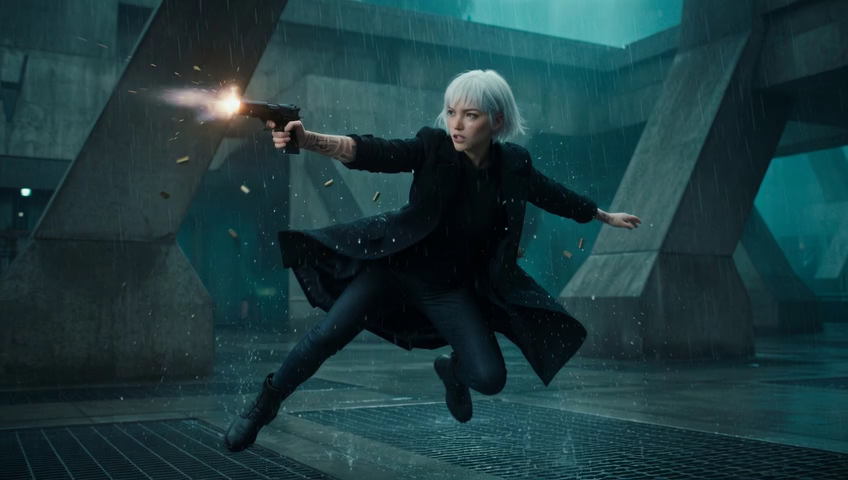
Slow Motion cinematic example

Footage captured at a higher frame rate than playback speed, stretching time to reveal details invisible at normal speed and amplifying impact, beauty, or emotional weight of a moment. Sam Peckinpah revolutionized screen violence with the slow-motion bloodbath of "The Wild Bunch," making destruction simultaneously beautiful and horrifying. The Wachowskis' "bullet time" in "The Matrix" became a cultural phenomenon, while Zack Snyder made speed ramping — shifting between slow and normal motion — his signature in "300." Wong Kar-wai uses slow motion with step-printing in "In the Mood for Love" to transform a woman walking past a noodle stand into pure visual poetry.

By Ivan Flugelman · Reviewed 16 July 2026

Prompt template

Slow motion capture at 240fps of [Subject] suspended in a single stretched moment, dust particles hanging motionless in shafts of light, every fine detail frozen in crystalline clarity, shot on Phantom Flex4K high-speed camera with Zeiss Master Prime glass, time stretched until a single second becomes an eternity of beauty

Replace [Subject] with your own character or scene. The prompt is technology-agnostic and works as a starting point for AI image or video generators.

When to use Slow Motion

Apply slow motion when a brief action contains detail or emotional weight that normal speed would hide. Impacts, fabric movement, water, dust, a fall, or a tiny facial response can become readable and monumental. It can make violence beautiful, grief suspended, or athletic motion analytical. Reserve it for selected beats; stretching routine movement without contrast often drains urgency instead of intensifying it.

Directing the AI

Choose one action and describe it as high-frame-rate capture played back slowly, with a clear beginning, peak, and release. Ask for crisp micro-detail in particles, hair, fabric, or debris while allowing natural directional blur on the fastest edges. Keep the camera move simpler than the subject action. State the perceived duration so one second expands meaningfully rather than freezing. Lighting should be strong enough to define each suspended element against the background.

Common mistakes

  1. Slowing an action with no hidden detail or emotional turning point, making the sequence feel padded rather than heightened.
  2. Removing all motion blur and producing a brittle sequence of frozen poses instead of continuous high-speed capture.
  3. Combining extreme slow motion with elaborate camera movement that distracts from the physical event being examined.
Sources and further reading

  1. 50+ Types of Camera Shots, Angles, and Techniques — StudioBinder
  2. Types of Camera Movements in Film Explained — StudioBinder

A shot is not a world

Learn the fourteen fundamentals for building consistent characters, environments, visual logic, and stories that expand beyond one beautiful frame. Get World Building Codex 3.0 free, or explore the World Building Academy.

Related techniques

Freeze Frame

Action suddenly stops as a single frame is held on screen — the exclamation point of cinema, used for endings, revelations, or comic emphasis. François Truffaut's freeze frame ending of "The 400 Blows" — young Antoine Doinel reaching the sea and turning to look directly at the camera as the image freezes — is one of cinema's most iconic final images. Martin Scorsese uses the freeze frame throughout "Goodfellas" as a storytelling device, and the final freeze frame of "Butch Cassidy and the Sundance Kid" immortalized its heroes mid-action. Spike Lee employs freeze frames with title cards as a recurring stylistic device.

Fast Motion

Footage played back faster than it was captured, compressing real-time action to create comedy, frenetic energy, or an accelerated sense of unstoppable momentum. Buster Keaton and Charlie Chaplin used undercranking to create the frenetic comedy of the silent era. Stanley Kubrick used fast motion for the threesome scene in "A Clockwork Orange" set to William Tell's Overture. Guy Ritchie employs speed ramping and fast motion in "Snatch" and "Lock, Stock and Two Smoking Barrels" as a signature stylistic device. Wes Anderson uses deadpan fast motion in montage sequences throughout "The Royal Tenenbaums" and "The Grand Budapest Hotel."

Time-Lapse

Capturing frames at intervals much slower than playback speed, compressing hours, days, or months into seconds to reveal processes invisible to normal perception — clouds racing, cities pulsing. Ron Fricke's "Koyaanisqatsi" (with Philip Glass's score) turned time-lapse into transcendent art, showing the rhythms of nature and civilization accelerated into hypnotic visual music. Terrence Malick uses time-lapse in "The Tree of Life" for cosmic creation sequences. David Fincher employed time-lapse in "Fight Club" and "The Curious Case of Benjamin Button" for both practical and poetic purposes. Modern nature documentaries by BBC and National Geographic have elevated time-lapse photography to a science.