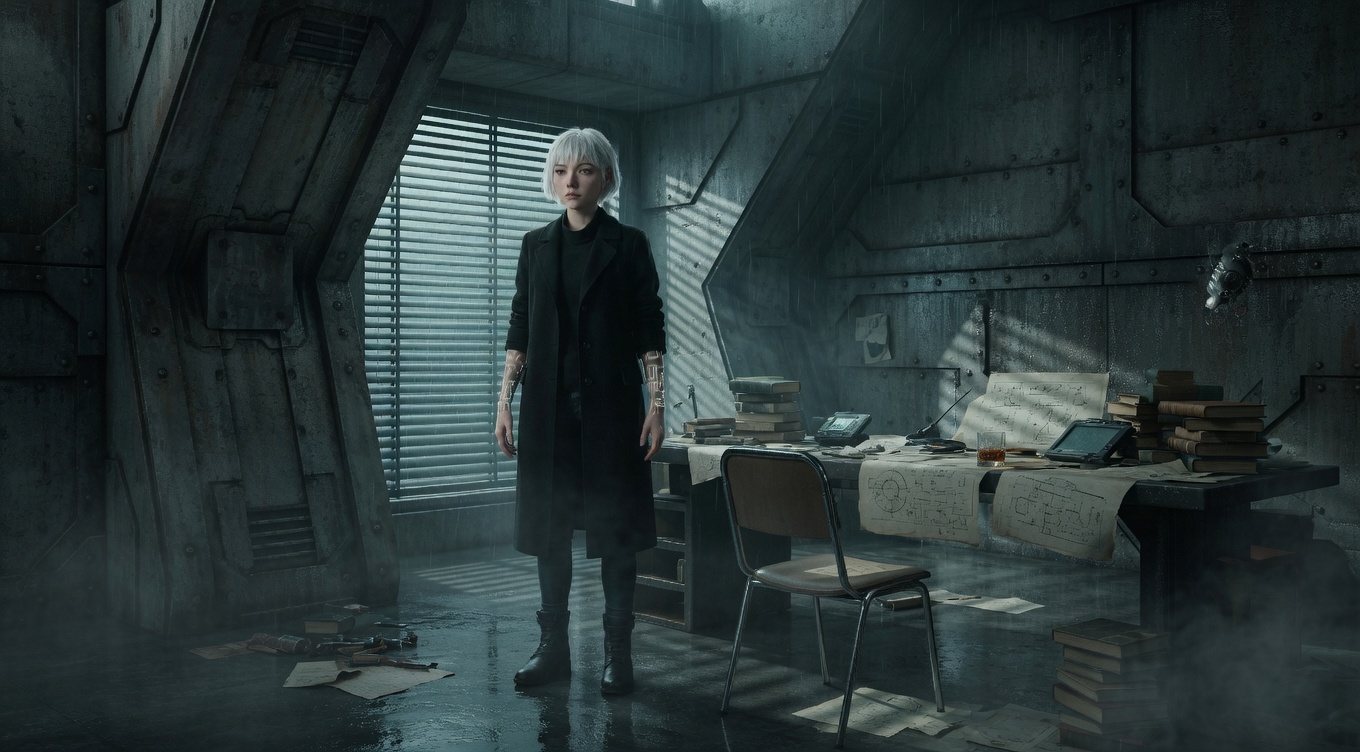
The total arrangement of everything visible in the frame — set design, props, costumes, lighting, actor positioning — where every element is a deliberate storytelling choice. The concept originates from French theater and was elevated to an art form by directors like Max Ophüls in "The Earrings of Madame de..." and Jean Renoir in "The Rules of the Game." Kubrick's obsessive mise-en-scène in "2001" and "Eyes Wide Shut" treats every prop and color as narrative text. Wes Anderson's mise-en-scène is so controlled it becomes the primary vehicle of storytelling, while Bong Joon-ho's "Parasite" uses the physical layout of the house as a map of class structure.
By Ivan Flugelman · Reviewed 16 July 2026
Prompt template
Meticulously arranged mise-en-scene with [Subject] positioned within an environment where every element tells a story, every prop researched and placed with production designer precision, the apparent normalcy concealing visible fault lines, shot on 35mm with a 32mm lens to capture the full space as a narrative environment, the Sirkian melodrama of a world where set design is psychology
Replace [Subject] with your own character or scene. The prompt is technology-agnostic and works as a starting point for AI image or video generators.
When to use Mise-en-Scène
Mise-en-scène is the right lens when the entire visible world must communicate character, class, history, or conflict before anyone speaks. Use it for controlled interiors, symbolic environments, ensemble blocking, and frames where props or architecture carry plot. It is especially valuable when building a repeatable visual world across scenes. Every object needs a reason to exist, but the arrangement should still feel inhabited rather than presented as a catalog of clues.
Directing the AI
Define the environment, period cues, palette, costume, props, lighting logic, and actor positions as one connected system. Assign each major object a relationship to the subject or story, then remove anything that does not support that relationship. Use depth and blocking to expose status or tension. Keep wear, spacing, and material detail consistent with the setting. For video, preserve object locations and costume continuity while allowing performers to interact naturally with the designed space.
Common mistakes
Listing attractive props without connecting them to character, conflict, or setting, creating decoration instead of visual storytelling.
Overloading every surface with symbolic objects, leaving the audience no hierarchy and the performers no believable living space.
Changing furniture, costume details, or practical-light positions across shots, breaking the coherence of the designed world.
A technique is one decision. A world is the system.
Internal logic is the set of laws that hold in your world whether or not anyone explains them. A shot that breaks them reads as a mistake even when it is beautiful.