← Cinematique Camera Work · Intermediate

Master Shot Prompt for AI Image & Video

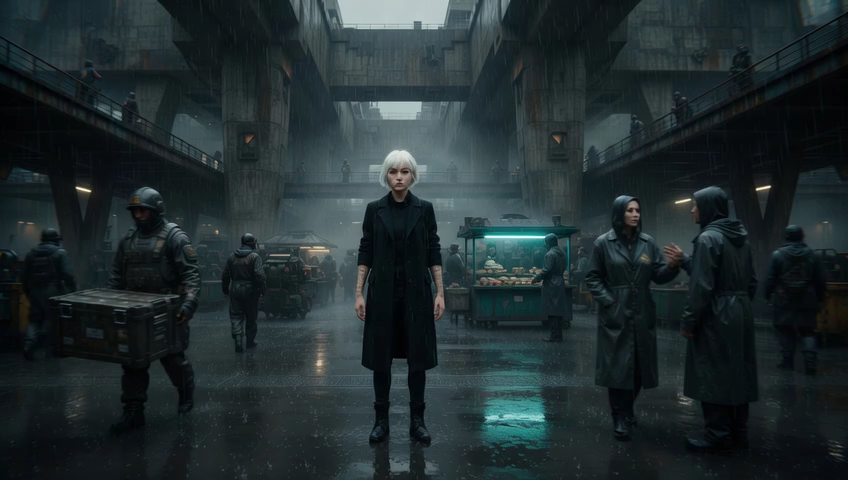
Master Shot cinematic example

A continuous wide shot that captures the entire scene from start to finish, serving as the foundation over which closer coverage is layered in editing. Robert Altman was famous for shooting elaborate master shots with multiple overlapping conversations in films like "Nashville" and "Short Cuts," trusting the wide frame to let audiences discover the drama themselves. Sidney Lumet staged masterful master shots in "12 Angry Men," choreographing twelve actors within a single room with balletic precision. Mike Leigh builds entire scenes from master shots that allow his actors' improvisational performances to breathe.

By Ivan Flugelman · Reviewed 16 July 2026

Prompt template

Wide master shot of [Subject] with all elements visible simultaneously, every figure precisely blocked to create a composition of intersecting eyelines and subtle tensions, shot on 35mm with a 27mm lens from a tripod, classical Hollywood staging with Altman-esque layered naturalism

Replace [Subject] with your own character or scene. The prompt is technology-agnostic and works as a starting point for AI image or video generators.

When to use Master Shot

Build a master shot when a scene depends on ensemble timing, spatial continuity, or the audience choosing where to look. It provides the full dramatic action in one wide composition and becomes a foundation for closer coverage. The format suits overlapping conversations, group conflict, and carefully blocked rooms. It is less effective when the setting cannot support layered action or when one face must dominate from the start.

Directing the AI

Show the entire playing area and every essential figure at once. Block actors on distinct depth planes with intersecting eyelines, clear entrances, and enough separation to read alliances or friction. Use a stable tripod perspective and a moderately wide lens rather than an exaggerated panorama. Lighting should motivate attention inside the frame without hiding secondary action. For video, describe the scene's full beginning-to-end choreography, not merely a wide opening before an automatic cut.

Common mistakes

  1. Arranging every actor in a flat line, which records the cast but reveals nothing about hierarchy or tension.
  2. Framing so wide that gestures and eyelines become unreadable, defeating the purpose of sustained ensemble staging.
  3. Calling a short location reveal a master shot even though it does not contain the scene's complete dramatic action.
Sources and further reading

  1. 50+ Types of Camera Shots, Angles, and Techniques — StudioBinder
  2. Types of Camera Movements in Film Explained — StudioBinder

A shot is not a world

Learn the fourteen fundamentals for building consistent characters, environments, visual logic, and stories that expand beyond one beautiful frame. Get World Building Codex 3.0 free, or explore the World Building Academy.

Related techniques

One-er (Oner)

An entire scene captured in a single unbroken take with no cuts, demanding precise choreography of actors, camera, and crew while creating real-time tension and immersive spatial continuity. Alfonso Cuarón and Emmanuel Lubezki pushed the oner to its limits in "Children of Men" with a six-minute car ambush shot, and Alejandro González Iñárritu structured the entirety of "Birdman" as one apparent continuous take. Alexander Sokurov actually achieved a true single-take feature film with "Russian Ark," 96 unbroken minutes wandering through the Hermitage Museum. Sam Mendes' "1917" used hidden cuts to create the illusion of a two-hour oner through World War I trenches.

Deep Focus

Everything in the frame — foreground, middle ground, and background — is in sharp focus simultaneously, allowing the viewer to explore the entire image and discover relationships between planes. Orson Welles and Gregg Toland made deep focus the defining visual innovation of "Citizen Kane" (1941), composing shots where action in the foreground, middle ground, and background all demanded simultaneous attention. William Wyler used deep focus in "The Best Years of Our Lives" to create some of cinema's most layered compositions. Jean Renoir's deep-focus staging in "Rules of the Game" lets multiple storylines play out in a single frame. The technique gives audiences agency — André Bazin argued it was more democratic than montage.

Mise-en-Scène

The total arrangement of everything visible in the frame — set design, props, costumes, lighting, actor positioning — where every element is a deliberate storytelling choice. The concept originates from French theater and was elevated to an art form by directors like Max Ophüls in "The Earrings of Madame de..." and Jean Renoir in "The Rules of the Game." Kubrick's obsessive mise-en-scène in "2001" and "Eyes Wide Shut" treats every prop and color as narrative text. Wes Anderson's mise-en-scène is so controlled it becomes the primary vehicle of storytelling, while Bong Joon-ho's "Parasite" uses the physical layout of the house as a map of class structure.