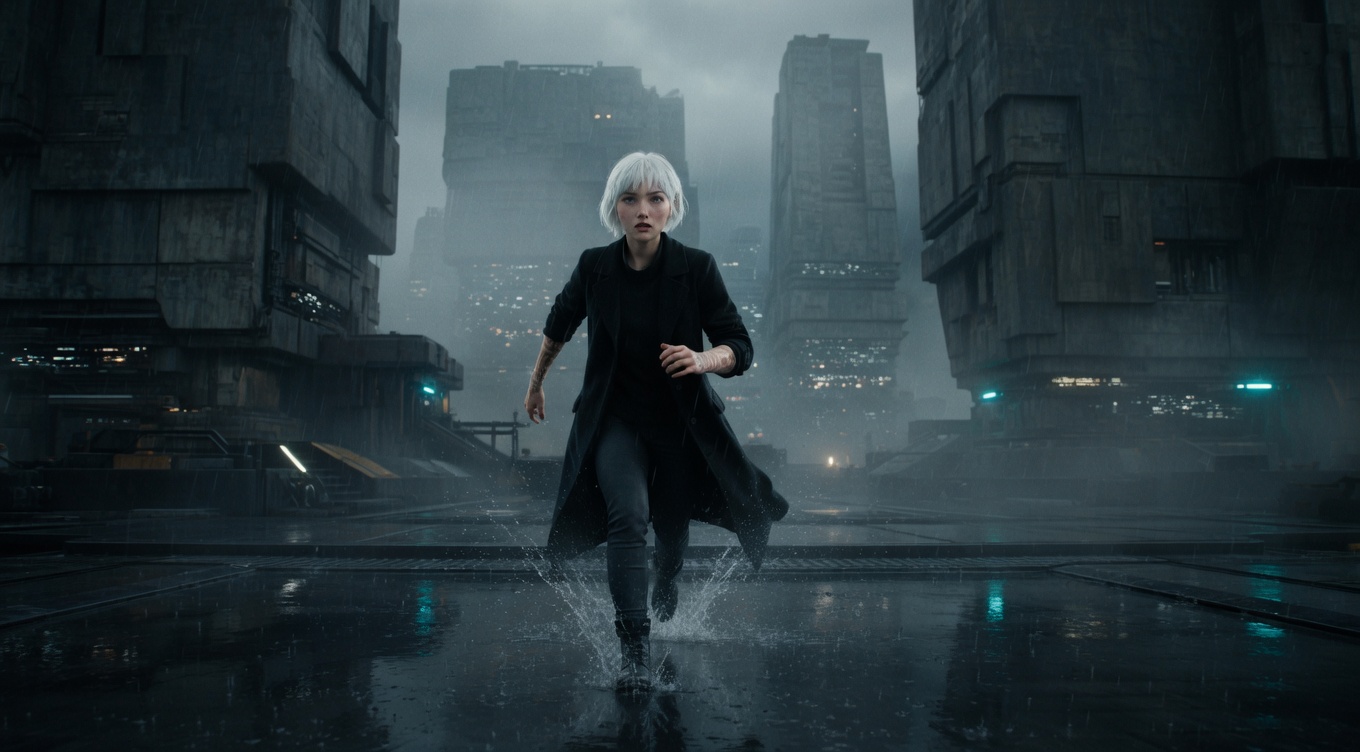
Beginning the story in the middle of the action rather than from the chronological start, hooking the audience immediately and creating mystery about how we got here. The technique dates to Homer's Odyssey and has been a staple of cinema since film noir. Quentin Tarantino opens "Reservoir Dogs" in the aftermath of a heist gone wrong, and Christopher Nolan begins "The Dark Knight" mid-robbery. The Coen Brothers drop viewers into the middle of violent chaos in "No Country for Old Men." Sam Mendes opens "American Beauty" with Kevin Spacey narrating from beyond the grave, and Danny Boyle begins "Trainspotting" with a full-sprint chase sequence set to Iggy Pop.
By Ivan Flugelman · Reviewed 16 July 2026
Prompt template
In medias res with [Subject] dropped without context into the middle of intense action already in progress, no exposition or setup, no explanation, the audience thrown into adrenaline and forced to piece together the story from fragments, handheld camera energy and desaturated color grade, the Tarantino-Nolan principle that starting in the middle makes the audience lean forward
Replace [Subject] with your own character or scene. The prompt is technology-agnostic and works as a starting point for AI image or video generators.
When to use In Medias Res
Use in medias res when the opening needs immediate pressure, movement, or mystery. Start after the plan has failed, during the chase, or at the instant a relationship breaks, then let context emerge through behavior and consequences. It suits stories where discovery is part of the pleasure. Even without exposition, viewers need a concrete objective, threat, or question to orient their attention inside the chaos.
Directing the AI
Open on action already underway: the subject running, hiding, arguing, escaping, or recovering from an unseen event. Use reactive handheld framing, compressed background information, and visible consequences such as damage, breathlessness, or scattered objects. Withhold names and explanations, but make the immediate stakes legible through direction of movement and character focus. Seed two or three contextual fragments that can be understood later. Do not pause the scene to explain how everyone arrived there.
Common mistakes
Withholding every point of orientation, turning deliberate mystery into a scene with no readable objective.
Stopping the action for immediate exposition, which cancels the momentum created by the opening plunge.
Staging generic chaos without specific consequences that hint at the unseen events preceding the scene.