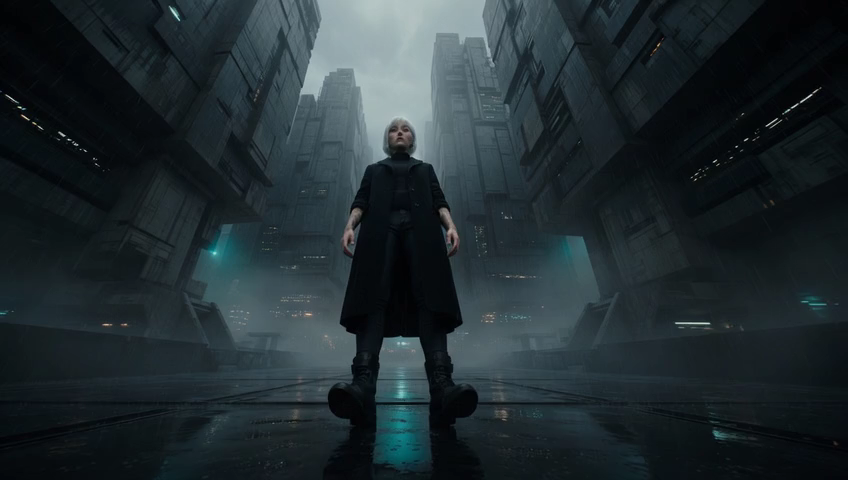
Camera placed at ground level looking straight up, the most extreme low angle, making everything tower above and creating a sense of awe, intimidation, or childlike wonder. Orson Welles was famous for his low-angle work in "Citizen Kane" and "The Trial," often requiring sets to be built with ceilings — unusual for the era. Terry Gilliam employs worm's eye views in "Brazil" and "12 Monkeys" to make bureaucratic architecture oppressive. Denis Villeneuve used ground-level upward shots in "Arrival" when the characters first approach the alien ship, capturing the vertigo of encountering something incomprehensibly vast.
By Ivan Flugelman · Reviewed 16 July 2026
Prompt template
Worm's eye view from ground level looking straight up at [Subject], the perspective so extreme that vertical elements seem to lean inward and threaten to collapse, shot from a camera placed directly on the ground with a 14mm ultra-wide rectilinear lens pointed straight up, the barrel distortion adding to the vertiginous effect, the overwhelming scale from the perspective of the smallest creature
Replace [Subject] with your own character or scene. The prompt is technology-agnostic and works as a starting point for AI image or video generators.
When to use Worm's Eye View
Choose a worm's eye view when the camera should occupy the smallest possible position beneath something immense. Looking almost straight up can make a building, creature, vehicle, or person feel oppressive, astonishing, or childishly wondrous. It is more extreme than a normal low angle and strongly abstracts space. Use it for encounters with scale; avoid it when facial readability or ordinary geography must remain clear.
Directing the AI
Place the lens directly on the ground and aim nearly straight upward. Use an ultra-wide rectilinear perspective so vertical structures surge inward toward the sky while remaining recognizably architectural. Include a small ground-edge reference for scale and position the subject above or around the lens, not merely in front of it. Control barrel distortion rather than letting it dominate. In video, use a slow tilt or passing overhead movement, preserving the grounded viewpoint.
Common mistakes
Positioning the camera around waist height, which produces an ordinary low angle without the creature-level viewpoint.
Aiming forward instead of upward, losing the collapsing verticals and overhead dominance central to the technique.
Letting ultra-wide distortion bend every line randomly, turning controlled vertigo into an unreadable fisheye effect.