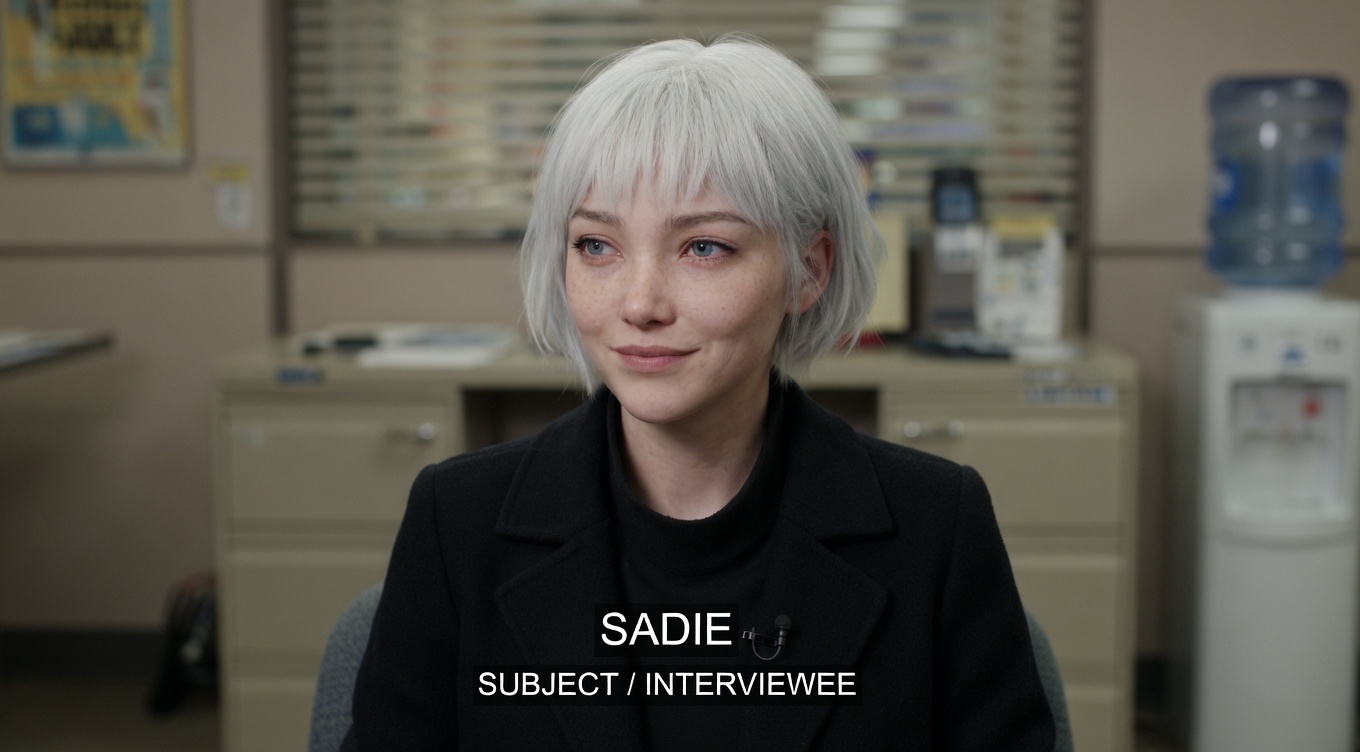
A fictional film presented in documentary style — talking head interviews, observational camera work, title cards — creating comedy through the contrast between the serious form and absurd content. Rob Reiner's "This Is Spinal Tap" (1984) established the mockumentary as a legitimate comedic form. Christopher Guest continued the tradition with "Waiting for Guffman," "Best in Show," and "A Mighty Wind." Ricky Gervais and Stephen Merchant's "The Office" (UK) made the mockumentary format a television staple, leading to the American version and eventually "Parks and Recreation" and "Modern Family." Taika Waititi's "What We Do in the Shadows" brought the mockumentary to horror-comedy.
By Ivan Flugelman · Reviewed 16 July 2026
Prompt template
Mockumentary talking head interview with [Subject] looking slightly off-camera to an unseen interviewer, standard documentary medium close-up with unflattering fluorescent lighting, the documentary format treating the setting with the visual gravity of a war correspondent's confession, handheld camera occasionally reframing to maintain the documentary illusion, the Christopher Guest understanding that absurd comedy requires deadpan documentary treatment
Replace [Subject] with your own character or scene. The prompt is technology-agnostic and works as a starting point for AI image or video generators.
When to use Mockumentary
Use mockumentary when comedy depends on fictional characters treating absurd events with complete documentary seriousness. Talking-head interviews can contradict observed action, reveal vanity, or let a glance expose what dialogue will not. The format suits workplace, community, performance, and social satire. Keep the camera’s behavior credible and restrained; if the filmmaking starts announcing jokes, the deadpan contrast loses its bite.
Directing the AI
Frame the subject in a standard medium close-up, looking slightly off-camera toward an unseen interviewer. Use plain fluorescent or window light, a functional background, and minimal visual flattery. During observational scenes, let the handheld camera reframe late, zoom slightly toward revealing reactions, or catch a private glance into lens. Keep titles and composition sober. Treat every ridiculous statement with the visual gravity of serious testimony, never adding comic effects to explain the joke.
Common mistakes
Lighting and framing interviews like glossy commercials, weakening the contrast between serious form and absurd content.
Adding comic zooms to every line, making the camera beg for laughs instead of observing behavior.
Having characters perform obvious jokes for the lens rather than protecting their sincere documentary reality.